Law firm chatbot: screening before the first consultation
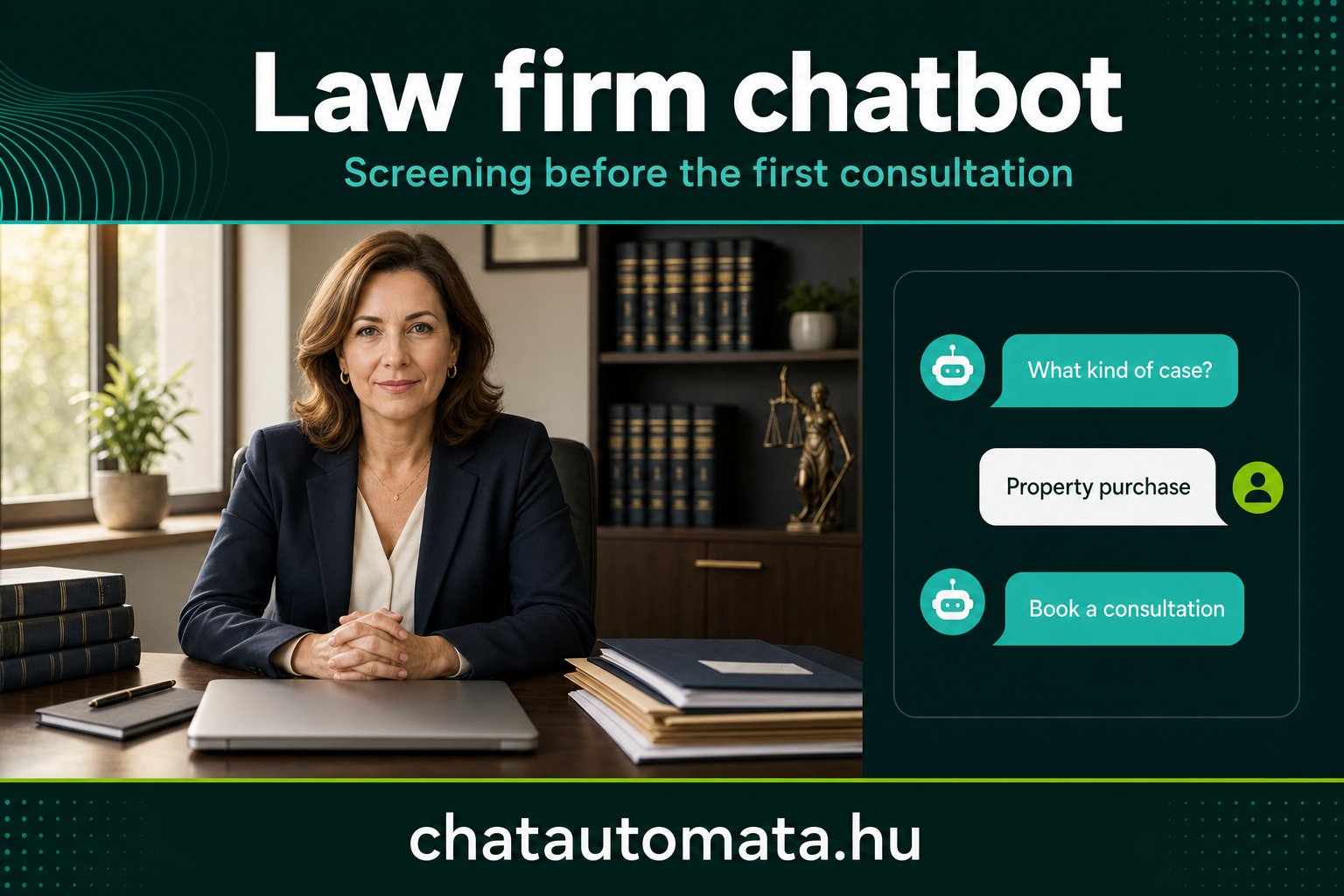
In a law firm, the first phone call is rarely about what it should be about. The caller starts telling their story — in detail, emotionally, for twenty minutes — and only at the end does it turn out that nobody in the office handles that kind of matter. Or somebody does, just not the person who picked up the phone.
That is not the caller's fault. Someone looking for a lawyer for the first time does not know that a divorce case and a property transaction are two different specialisms, nor what they should say to simply get an appointment.
This article looks at what a chatbot can take over from this — and, just as importantly, what it must never be trusted with.
Why is a law firm different from any other service business?
At a hair salon, the chatbot asks three things (what, when, with whom) and the booking is done. At a law firm, those same three questions carry legal risk.
Legal privilege does not begin with the lawyer: it already covers the first contact. If someone types into a chat window that "my husband moved out and does not pay child support", that is a sensitive, identifiable life situation — and from that moment on it sits in a database.
So the logic is reversed. For a webshop, a good chatbot is one that learns as much as possible about the customer. For a law firm, it is one that learns as little as possible — but that little, precisely.
What should the chatbot screen for?
Three things are worth clarifying before the consultation, and all three can be answered without anything sensitive being said.
1. The type of matter. Not the story, but the category: family law, property law, employment law, civil law, corporate law, criminal law. Three or four questions settle it, and from there it is clear which colleague it belongs to.
2. Urgency. Some matters have deadlines measured in days; others can wait for months. In the ChatAutomata setup for law firms this breaks down into three bands: within seven days, within thirty days, or no rush. This classification decides which free slot the system offers first.
3. The fee structure. The most common point where people drop off is not knowing what to expect. If the bot explains up front that the firm works on an hourly rate, a value-based fee or a flat fee, and roughly in what range, the client arrives at the consultation already knowing this.
These three pieces of information are enough to route the booking to the right specialist with the right urgency — while not a single case detail has been recorded.
Where legal privilege draws the line
This is the most important setting, and unfortunately the one most often skipped. A chatbot is curious by default: unless you tell it where to stop, it will keep asking until it "understands the case".
What is worth explicitly forbidding:
- asking for the other party's name or details
- collecting specific amounts, contract numbers or case reference numbers
- any question about "what exactly happened"
- asking for documents to be uploaded into the chat window
- offering a legal opinion or an estimate of the chances ("you will probably win this")
One sentence works better than any of these: "Please discuss the details with the lawyer — I only check who to book you with, and when." That sentence protects the client, the firm and the bot at the same time.
The same logic applies to storage: whatever is said has to be stored somewhere. The less is said, the smaller the liability. We wrote about this in more detail in our article on chatbots in medical practices — the data protection logic described there applies to law firms too.
Fees: how much may the bot say?
Many firms keep prices off their website because cases are not comparable. That is true — but the caller still has a question, and if they get no answer at all, they keep looking elsewhere.
The workable middle ground is the range and the structure. You do not say "this case costs this much", but rather how the firm calculates and roughly in what band. For example: the consultation has a fixed fee, case handling is hourly, property transactions are value-based. In most cases those three sentences are enough for the caller to decide whether it is worth sitting down.
There is a side effect that helps the firm too: someone who reads this and still books an appointment already knows what they are getting into. Fewer misunderstandings when the first invoice arrives.
What do people actually ask?
Someone looking for a lawyer for the first time rarely asks in legal language. They do not write "I am seeking representation in civil litigation", they write "how much does it cost to sue my neighbour".
That difference matters when configuring the chatbot. If it only recognises professional terminology, half of your visitors get stuck at the first question. It is worth adding everyday phrasings to the knowledge base as well.
The most common first questions fall into roughly three groups:
- Price: how much a consultation costs, and what comes after
- Relevance: whether the firm handles this type of matter at all
- Timing: when they can be seen, and whether the matter is urgent
If those three can be answered in the chat window, a large share of phone calls arrive as bookings rather than as enquiries. We saw the same pattern with photographers — our article on chatbots for photographers describes how screening price enquiries freed up the same kind of time.
What should you never trust to a chatbot?
This section matters more than all the previous ones combined.
Legal advice. Never, in any form. Not even "in general terms". A language model writes confidently even when it is wrong, and in a legal question a confident error costs more than silence.
Deadline calculations. "How long do I have to appeal?" — the bot should not answer that with a number. Procedural deadlines vary by case type and circumstances, and a wrong number can be fatal.
The sensitive first moment. Someone contacting a lawyer because of abuse, a death in the family or a child custody matter does not need a chat window. It is worth building in an exit: on certain keywords the bot should hand over the phone number immediately and stop asking.
Winning the client over. A chatbot arranges appointments; it does not build trust. Trust is built in the first conversation — the bot's job is simply to make sure that conversation happens at all, with the right person.
And there is a fourth one that is rarely discussed: screening out the opposing party. It happens that the other side of an ongoing matter contacts the firm — sometimes deliberately, sometimes by accident. A chatbot cannot detect this, and it is not its job. This is exactly why it should record nothing that identifies the matter: if the conflict of interest only surfaces at the consultation, the situation stays clean, because nothing substantive was said before that.
A good rule of thumb: if the answer to a question is something a lawyer would only say after being retained, the bot must not say it either.
What happens after the booking?
A booked consultation is only worth something if the client shows up. For that, the confirmation needs to contain more than a time slot: the location or the video call link, the fee structure, what to bring, and where to park.
This sounds trivial, but a significant share of no-shows simply comes from the client not knowing where to go, or not being sure that what they are bringing will be enough. A well-written confirmation email is cheaper than a lost hour.
For simple forms — powers of attorney, declarations, client data sheets — the bot can send the template in advance so the client arrives with it filled in. The legal content naturally stays with the lawyer; the bot only hands over the paperwork.
Messenger or website?
For law firms, website chat is the more natural entry point: people looking for legal help usually search deliberately rather than stumbling upon the firm on social media.
Messenger is a useful addition if the firm has an active page and receives enquiries there. ChatAutomata serves both channels from the same knowledge base, so there is no need to configure it twice — but it is worth knowing that people writing on Messenger use a more casual tone and more often type things they would be better off not typing.
So on the Messenger channel the "do not ask for details" rule should be even stricter, and the handover to a phone call or an in-person meeting should come sooner.
How to get started
Do not bring the whole firm online at once. The fastest result comes from setting up one thing: case-type screening and consultation booking routed to the right colleague.
The practical steps:
- List the case types the firm handles and which colleague each belongs to.
- Decide what the bot must NOT ask — this list should be longer than what it may ask.
- Write the three sentences about your fee structure.
- Connect the calendar and set what goes into the confirmation email.
- Live with it for two weeks and see what people ask that you did not anticipate.
The fifth point is the most valuable. Real questions are always different from the ones we prepared for — and after two weeks it becomes clear where to refine.
What does it cost?
ChatAutomata's plans are sized for Hungarian small businesses: Starter HUF 4,990/month, Pro HUF 14,990/month, Business HUF 39,990/month. There is a free plan with no time limit, and the paid tiers can be tried for 14 days without entering card details.
At a law firm, the return is usually not measured in saved phone calls, but in how many consultations happen that would otherwise not have — because the caller could not reach the office, or did not dare to pick up the phone.
You can read about the settings tailored to law firms on our consultation assistant page, and start a trial from the demo page.
One closing note: from 2 August 2026 the EU AI Act requires visitors to be informed when they are talking to a machine. This is not a drawback — at a law firm it actively builds trust if it is made clear in the first sentence. We collected the details on our AI Act page.