Chatbots in medical practices: what to ask, what never to store
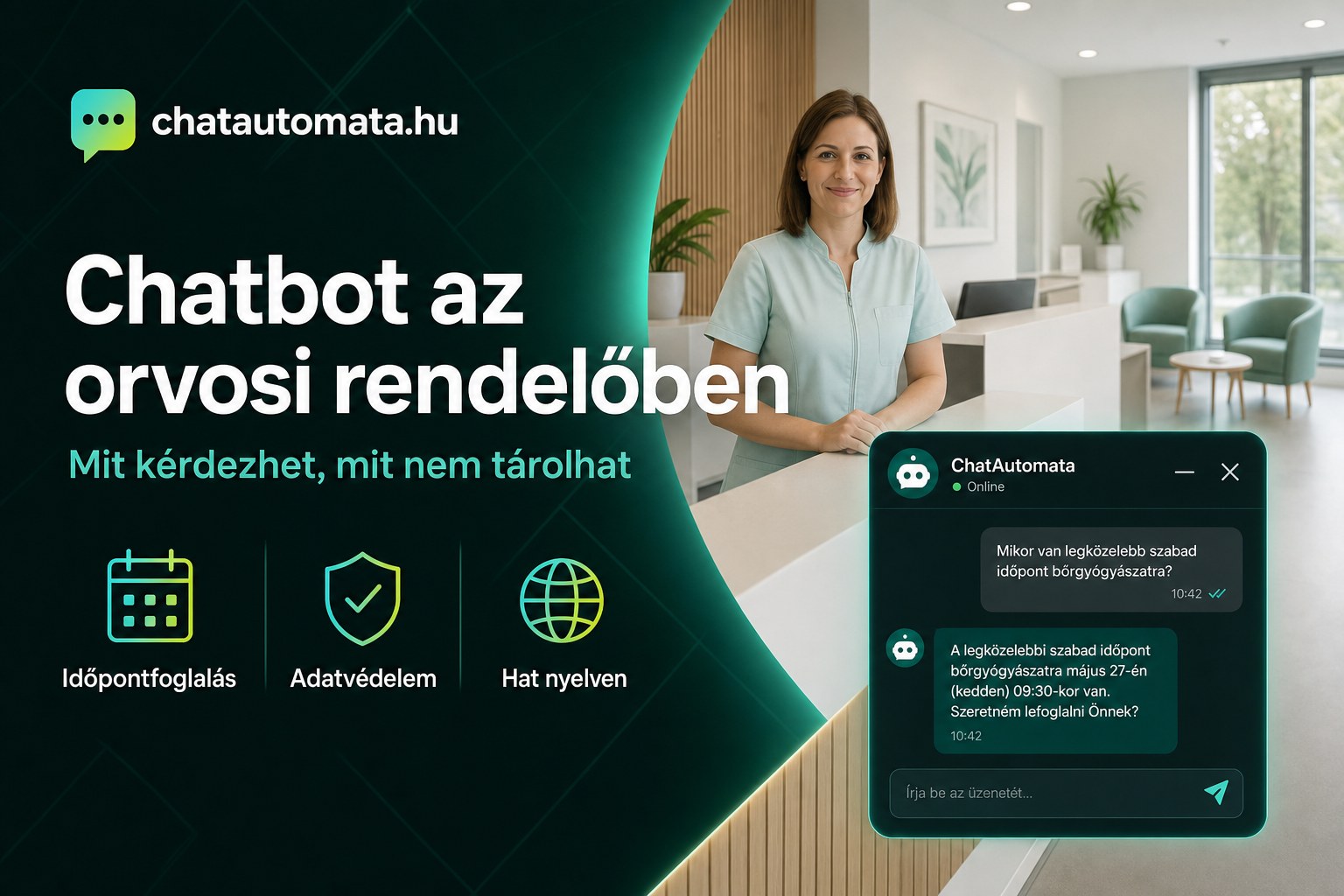
Fifteen calls are waiting at reception at eight in the morning. Half want an appointment, a quarter are asking about opening hours, the rest need a repeat prescription. A chatbot takes that load off — except that the stakes in a medical practice are different from those in a webshop. There, a bad answer means a botched order. Here, health information enters the conversation, and under the GDPR that is a special category of data.
This article is about where the line runs: what the bot can ask freely, what it should ask carefully, and what it must never keep.
Why health data is different
Article 9 of the GDPR treats "data concerning health" as its own category. In practice that means this: while a name and a phone number can rest on legitimate interest or contract performance, data about someone's state of health needs a stricter basis — usually explicit consent, or one of the separate grounds tied to the provision of healthcare.
And here is the twist people tend to miss: health data is not just a diagnosis. The fact that someone is booking with a dermatologist is health data. So is "my knee has hurt for two weeks." Even an enquiry about one particular specialty can be revealing on its own.
So the moment your chatbot asks about symptoms, it is already processing special category data. It can still be entirely lawful — it just can't be configured as if it were taking a pizza order.
What it can ask freely
There is a wide band where the bot can work without trouble, because it isn't collecting information about someone's health — it's collecting information about logistics:
- Which specialty do you need an appointment with? — routing, not diagnosis
- Have you been here before? — new versus returning patient, a scheduling question
- What time of day suits you? — calendar logic
- Where can we reach you? — needed for the confirmation
- Is it urgent? — more on this in a moment
That layer alone saves a lot of phone calls. In the ChatAutomata setup for medical practices, the chatbot works from a separate calendar per doctor, offers available slots, and adds people to a waiting list when there are none — while reception sees the booking immediately via webhook.
What it should ask carefully — and why
Asking about the nature of the complaint is useful, because that is what gets the patient to the right specialist. But this is where you have to make a deliberate decision about how much detail is actually necessary.
A good pre-screening sequence asks only as much as routing requires, and no more:
- the type of complaint (toothache, follow-up, consultation)
- how long it has been going on
- whether it has been treated before
What does not belong in a chatbot: detailed medical history, lists of previous diagnoses, drug allergies, pregnancy, questions about mental health. Those things matter — they simply don't belong in a web form or a chat window. They belong between the doctor and the patient.
A useful rule of thumb: if the answer to a question would give away the diagnosis by itself, the bot shouldn't be the one asking it.
What the bot MUST recognise: urgency
This is where a medical chatbot cannot be like any other. If someone mentions chest pain, loss of consciousness or sudden difficulty speaking, the correct behaviour is not to offer an appointment — it is to point them to emergency services immediately.
The ChatAutomata configuration for practices does exactly this: it separates urgent from non-urgent cases based on the described complaint, and for urgent ones it doesn't book anything — it directs the person to emergency care.
Two things are worth adding, because without them the feature would be misleading:
- The bot does not diagnose. It doesn't tell anyone what is wrong — it recognises that this particular situation cannot wait until tomorrow.
- The list is your responsibility. What counts as urgent in a given specialty is a decision for the doctor, not the software. Write that list together during setup.
What happens when the bot doesn't know?
In a medical practice this matters more than anywhere else. In a webshop an invented answer is embarrassing; here it can do real harm.
The right behaviour is simple: if the chatbot can't find the answer in its own knowledge base, it should not invent one. It should say it can't answer that, and offer a real path forward — a callback, an email address, or a handover to reception. ChatAutomata works this way by default: it builds answers from the uploaded knowledge base, and when there is nothing to back an answer up, it asks for contact details instead of improvising.
For a practice this isn't a convenience setting, it's a line of defence. The most common reason a bot ends up giving medical advice is precisely that it feels obliged to answer something. If the system is allowed to calmly say it doesn't know, it won't start guessing.
It's worth reviewing what's in the knowledge base before you go live. Opening hours, the list of specialties, preparation instructions (fasting before bloodwork, for instance), parking and referral questions all belong there. Anything that isn't in it, the bot won't be able to answer — and that is exactly as it should be.
What to store — and for how long
The most common mistake isn't in the questions. It's that everything is kept. Chat transcripts sit in the system for months because nobody thought about deletion.
Worth working through before you launch:
- What moves into the patient record, and what stays only in the chat? The booking details move across. The text of the conversation rarely has a good reason to survive.
- How long do you keep conversations? Pick an actual number, and make the deletion automatic. "We'll clean it up at some point" is not a retention policy.
- Who has access? Reception needs access to the booking, not necessarily to the full description of symptoms.
- Where is it stored? EU-based servers and encrypted storage — ChatAutomata works this way, but check it separately with any provider.
And a separate warning, because this one is easy to walk into: the chat should never collect or send national health identifiers, ID numbers or prescription data. For a repeat prescription, the chatbot's job is to gather the request and flag it to the practice — sensitive identifiers should stay in the practice's own dedicated system, not in a chat transcript or an email.
Disclosure is not optional
If it isn't clear at the start of the conversation that the person is talking to a machine, that is a problem in itself — the EU AI Act (Regulation 2024/1689) requires people to know when they are interacting with an AI system. We've written about this separately on our AI Act page.
In a medical setting it's also a question of trust. Patients answer honestly when they know who they're talking to and what will happen to what they write. Three sentences at the top of the chat are worth more than a long notice nobody reads:
- this is an automated assistant, not a doctor
- your answers are used to arrange an appointment
- in an emergency, call emergency services
Multiple languages: not just for tourists
More and more practices see patients who don't speak the local language well — refugees, families who have moved for work, international students, employees of multinational companies. Sorting things out by phone is hard on both sides, and misunderstandings are the expensive part: an appointment booked with the wrong specialist, a missed examination.
Writing works far better than speaking here. Patients write in their own language, have time to phrase it, and aren't embarrassed to ask. The ChatAutomata setup for practices understands Hungarian, English, German, Romanian, Slovak and Ukrainian — the bot detects the language, or the visitor picks one.
From a privacy standpoint nothing changes: the same rules apply in every language. What you wouldn't ask in one language, you don't ask in another.
Three mistakes we see often in practices
1. The bot gives medical advice. This is the most serious one, and it usually isn't deliberate: someone tunes the bot to be "helpful", and it assembles an answer from the knowledge base about what the patient should do. A chatbot can route and inform, but it cannot say what is wrong or suggest treatment. This has to be explicitly forbidden in the configuration — hoping isn't enough.
2. There's no way through to a human. If the patient is upset, or the situation doesn't fit the question flow, they need to reach a person straight away. That's what operator takeover is for in ChatAutomata: reception can step into a live conversation and answer from that point on. That option also has to be visible — nobody should have to guess it exists.
3. Nobody reads the privacy notice. A long data protection notice at the bottom of the chat window may be legally fine, but it informs nobody. Two short sentences where the question is actually asked are worth far more: "we ask this so we can route you to the right specialist."
How to roll it out — four steps
1. Write down what reception asks today. Don't start with the bot, start with what already works. The ten most frequent questions give you its backbone.
2. Draw the line together with the doctor. Which symptom questions stay, which go, and what counts as urgent. That is a clinical decision.
3. Set the retention period before you go live. It's much harder afterwards, and data piles up in the meantime.
4. Read through the first two weeks of conversations. Not to see what the bot answered, but to see what people typed in. If they wrote things they shouldn't have, your questions are what needs changing.
In summary
With a chatbot in a medical practice, the hard part isn't the technology. Appointment booking, per-doctor calendars, multiple languages — those are a given by now. The work lies in deciding how much it asks and how much it forgets.
A good practice bot asks little, routes precisely, steps aside in an emergency, and afterwards holds on to nothing it doesn't need.
If you take one sentence away from this article, make it this: for every question, ask yourself what the answer is needed for. If there's a concrete, organisational answer — which doctor, what time, how to notify them — the question is justified. If you'd only be asking because "it's good to know", that question doesn't belong in a chatbot.
If you want to try it: the ChatAutomata free plan can be used indefinitely (100 messages a month), and every new account gets full Pro access for 14 days without a card. You can see the settings built for practices on the medical practice page.
This article is a practical summary, not legal advice. Data protection decisions — the legal basis and retention period in particular — are worth finalising with a privacy specialist.