Chatbot or live support: when does each one pay off?
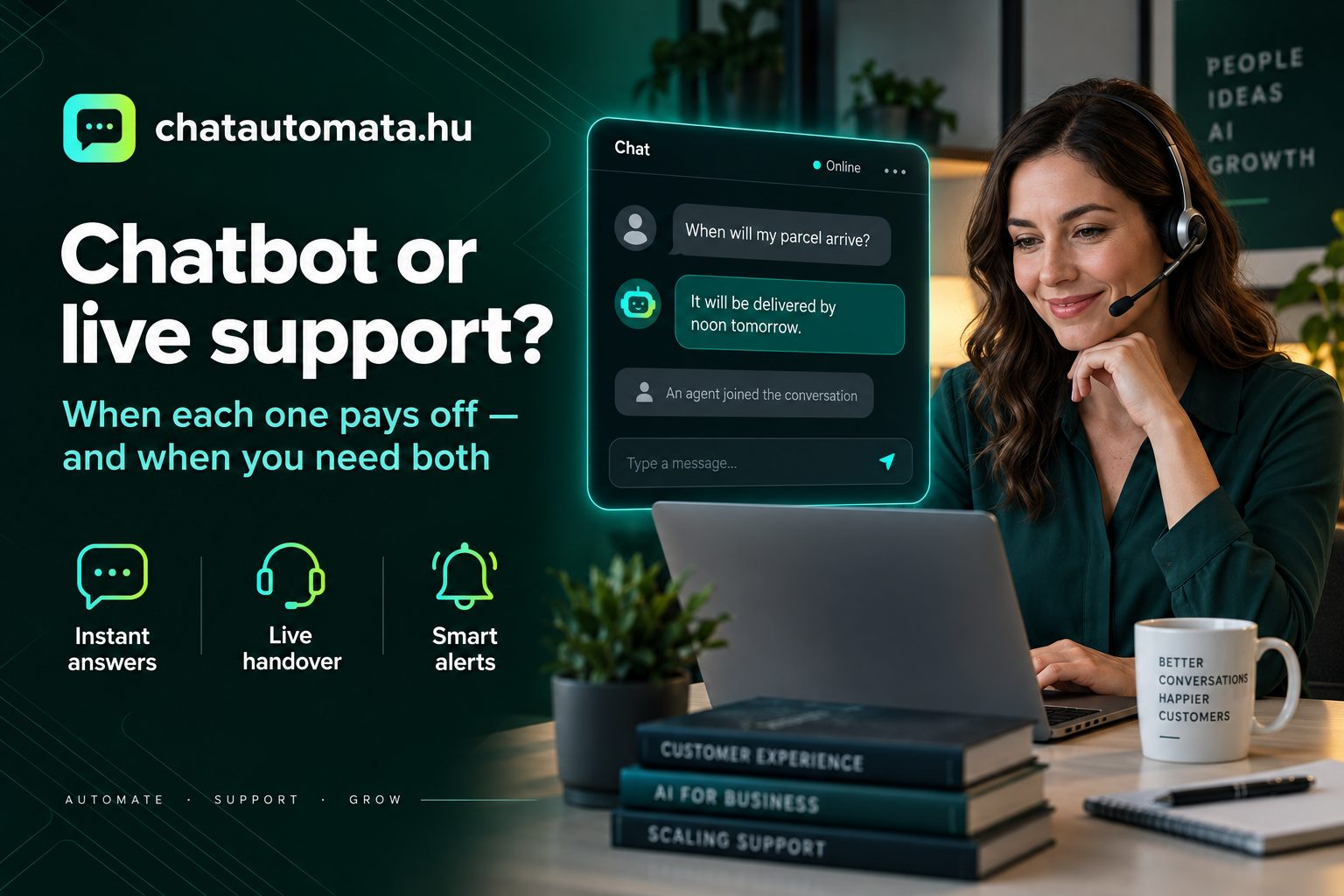
Most small business owners ask the wrong question: chatbot or human? The real question is who should handle which conversation. Most of what reaches customer support is repetitive: when will my parcel arrive, how much is it, is there a free slot, how can I pay. Each of these has one correct answer, and nobody needs to type it by hand again. A smaller share, though, needs a person: complaints, custom quotes, situations that run on trust.
This article helps you decide based on your own numbers, with a simple split instead of general enthusiasm.
What a chatbot does better
- It answers instantly, even at night. Someone asking at 11 pm doesn't wait until morning. For webshops and appointment booking, that's a tangible difference.
- It always says the same thing. When answers come from your own FAQ and documents, they don't depend on who is on shift.
- It doesn't get tired of the tenth identical question. Delivery times, opening hours, prices: exactly the questions that eat up your team's time.
- It handles peaks. After a sale or an ad campaign, ten times as many people may write. A chatbot doesn't need an extra hire for that.
A well-configured chatbot doesn't guess. ChatAutomata, for example, answers from your own knowledge base, and when it can't find the answer, it doesn't make one up. It asks for the visitor's contact details so someone on your team can reply.
What a person does better
- Complaints. An angry or disappointed customer isn't looking for a correct answer. They want to be heard.
- Custom quotes. When a request doesn't fit a package, a person handles it best.
- Sensitive matters. Health, legal, money: here visitors want a human on the other side.
- The "I'm not sure what to ask" situation. When someone is still figuring out their problem, a good colleague asks back and guides them.
How to calculate whether it pays off
You don't need market research, just one week's sample from your own inbox and chat:
- Count your weekly questions and split them into two piles: repetitive (there's a ready answer) and unique.
- Measure how long one repetitive answer takes, including looking things up and typing.
- Multiply: number of repetitive questions × minutes × your colleague's hourly cost. That's the work a chatbot takes off your plate each week.
- Compare it with the price. ChatAutomata's Starter plan is HUF 4,990 per month (1,000 messages), Pro is HUF 14,990 per month (10,000 messages). There's also a free plan with no time limit and 100 messages a month, which is enough to try it out.
If the first two steps show that most of your questions are unique, a chatbot will be useful as a helper: booking, collecting details, taking messages at night. If most are repetitive, it frees up a significant part of your team's time.
The best answer is usually both
Instead of either-or, most small businesses do best with a hybrid model: the chatbot gives the first answer and hands difficult cases to a person. That takes three things:
- Live handover. In ChatAutomata, a team member can take over a conversation at any time. The visitor sees that a person is now replying, and the conversation can be handed back to the bot afterwards.
- Alerts at the right moment. You can set the system to notify you when a conversation contains words like "complaint", "urgent" or "refund", when the bot couldn't find an answer, or when a conversation runs suspiciously long.
- Handoff to your existing tools. If you already use helpdesk software, the conversation can continue as a ticket in Zendesk, Freshdesk or Intercom, with its full history. Your colleague keeps working in the tool they know.
When NOT to start with a chatbot
To be honest, sometimes it's not worth it:
- You get only a few enquiries a week, and they are all unique.
- Nothing is written down: no FAQ, no price list, no delivery terms. A chatbot works from what you give it. In that case, step one is writing your FAQ, which helps your human customers too.
- The core of what you sell is personal advice, and that's exactly why customers choose you.
Frequently asked questions
Will visitors notice they're talking to a chatbot?
Yes, and that's how it should be. Under the EU AI Act, people must be told when they are interacting with AI. In practice, people don't mind that. What they mind is a wrong or slow answer.
What happens if the chatbot doesn't know the answer?
It doesn't invent one. It asks for the visitor's contact details and notifies you so you can reply. This also shows you what to add to the knowledge base.
Do I need a support team alongside it?
Not necessarily. In a one-person business, the "team" is you: the bot takes the questions, and you step in only when you get an alert.
In short
A chatbot is strong on repetitive questions that need a fast answer. People are strong in unique, emotional and trust-based situations. For most small businesses, the two together work best: the bot answers instantly, and a person steps in where it really matters.
To try it on your own questions, see what the chatbot can do, or start with the free plan.