5 tips for a Hungarian webshop chatbot that actually sells
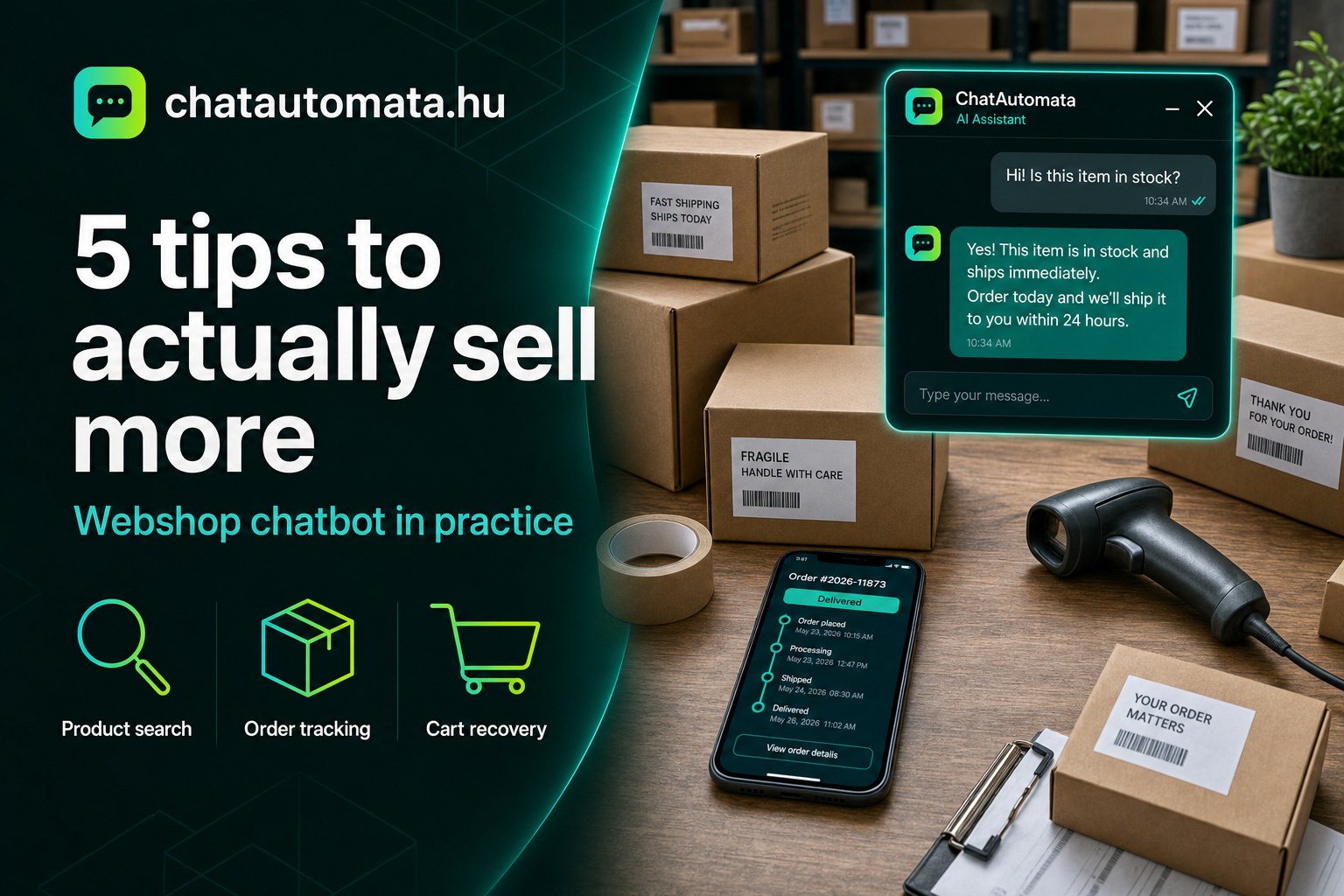
If you run a webshop, you have almost certainly seen a chatbot that is a purple bubble in the corner giving robotic answers. This article is about the other kind — the one that actually sells, rather than just being present.
1. A knowledge base, not canned replies
Most chatbots run on ten or twenty pre-written answers. The customer asks something outside the list, and gets "Sorry, I don't know that." End of conversation.
Retrieval-augmented generation works differently:
- You upload your product catalogue, terms, shipping information and FAQ
- The system splits them into chunks and makes them searchable
- When a customer asks, the bot finds the relevant few sentences and answers from them
The result is a bot that knows your actual products, prices, sizes and delivery times — in natural sentences rather than template fragments.
One practical consequence: the quality of your answers is the quality of your source material. A vague price list produces a vague chatbot.
2. Tool-calling — let it act, not just talk
A genuinely useful bot does more than reply. It:
- Looks up order status in WooCommerce or Shopify
- Checks live stock levels
- Suggests alternatives when an item is sold out
- Issues coupons and captures leads
- Books appointments
This is tool-calling: the bot calls your webshop's API in the background. The customer does not experience it as a bot — it behaves like a colleague who can actually look things up.
The difference matters most on the single most common question. "Where is my order?" answered with a link to a tracking page is fine. Answered with the actual delivery date is better.
3. Real Hungarian, not translated English prompts
Hungarian inflection and word order are genuinely difficult. A model tuned for English will produce sentences that are grammatically wrong in ways a native speaker notices immediately — and that damages trust faster than a slow reply does.
A chatbot built for the Hungarian market needs:
- Hungarian-aware search, including stop words and inflected forms
- Prompt tuning for Hungarian, including whether the bot uses formal or informal address
- A tone that fits Hungarian customer service, not an American "Awesome!" register
That third point is easy to underestimate. The formal-informal choice is a real decision in Hungarian, and getting it wrong makes the first sentence feel off.
4. Capture leads sensibly, not aggressively
The worst chatbots ask for an email address the moment they open. The good ones help first, and ask only when it makes sense:
- "Shall I send you the detailed quote by email?" — after the third message, not the first
- "Want me to let you know when it's back in stock?" — after they asked about an unavailable item
- "Should I remind you about your cart?" — when they have been on checkout for ten minutes
The pattern is the same in each case: the request follows something the customer already wanted.
5. Measure what you cannot see
Chat is a poorly measured channel in most webshops. The owner knows there is "some chat thing", but not:
- How many customers asked about order status — that is deflected support email
- How many leads the bot generated this week
- The top five most common questions — those are your drop-off points
- How many conversions went through a bot-recommended product
A conversation funnel and basic sentiment tracking are what tell you whether the bot is working or merely present.
This is also the cheapest source of website improvements you will find. If fifteen people ask the same question, that is a missing page, and now you know exactly what to write.
In short
The purple bubble in the corner was a 2018 solution. In 2026 an AI chatbot is a product recommender, a booking assistant and a support deflector at once — and it works in Hungarian.
The Pro plan bundles all five: knowledge base, tool-calling, Hungarian-tuned AI, lead capture and an analytics dashboard. There is also a free tier with no time limit, and the paid plans can be tried for 14 days without a card.
For the support-side numbers, see our piece on customer support automation for Hungarian webshops.