Chatbot for schools: the 10 questions every applicant asks
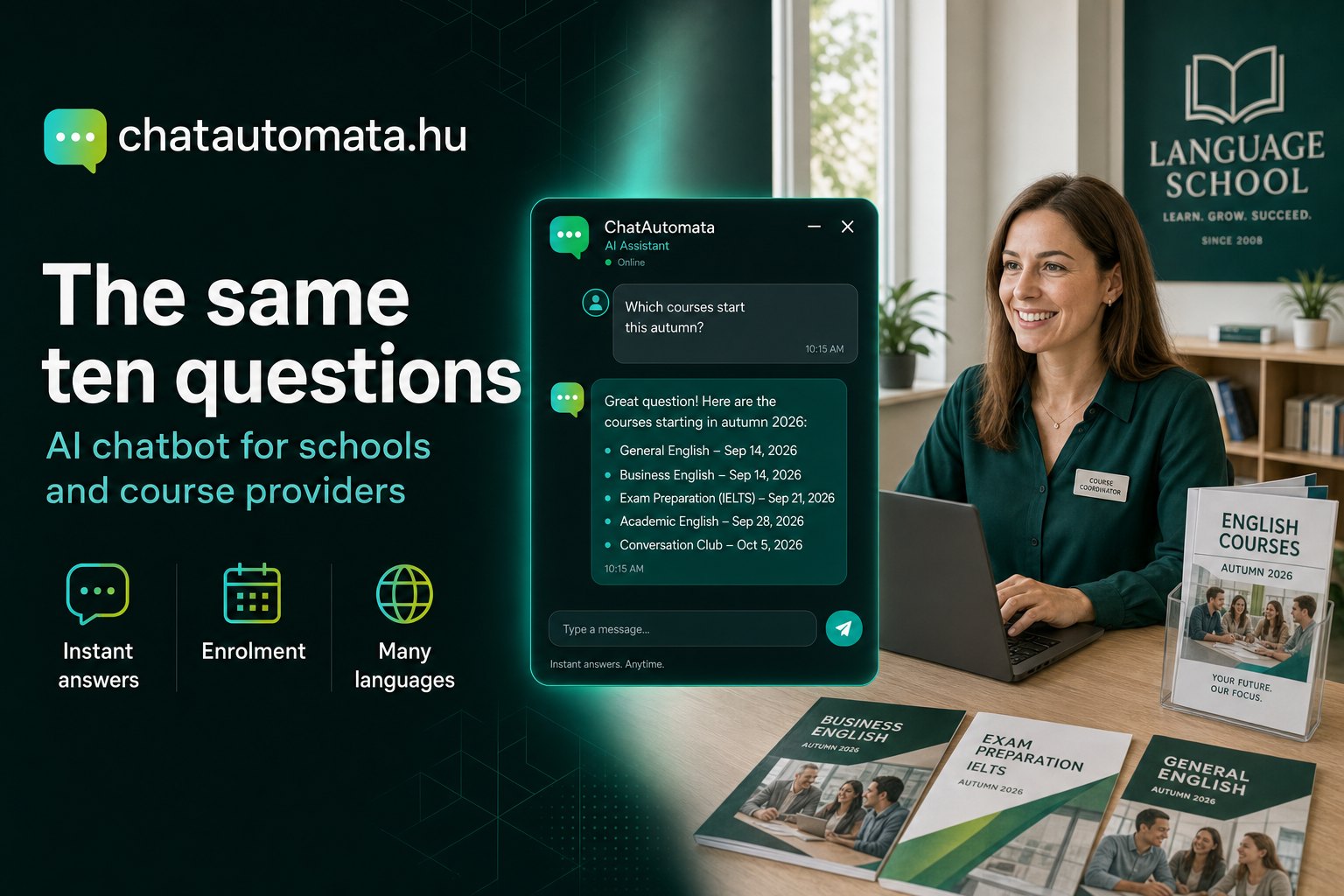
If you run a language school, a training course or a private academy, you know the picture: the inbox fills up in early September, and by the twentieth message you are writing the reply from memory. Not because it is dull, but because it genuinely is the same ten questions.
We went through a stack of Hungarian language-school and course-provider FAQ pages rather than guessing what people ask. The pattern is remarkably consistent.
The ten questions every applicant sends
- How much does it cost? Course fee, hourly rate, and what is included.
- When does the next group start? And what happens if I have missed it.
- What level am I? Is there a placement test, how long does it take, is it free.
- How many people will be in the group? For many, this is the real worry.
- How many hours in total, and how far will that get me? The "how long until I pass the exam" question never goes away.
- Can I pay in instalments? Asked far more often than you would think, and often decisive.
- What do I need to enrol? Application form, contract, deposit — in what order.
- Where are the classes, and is there an online option?
- What if I miss a session? Can it be made up, does it still count, is it simply lost.
- Do I get a certificate? And does the course prepare me for an official exam.
All ten sit at the very beginning of the applicant journey. Someone who does not get an answer rarely writes again — they move on to the next school.
"It only takes a minute" — until you multiply it
Writing one reply really does take three or four minutes. But in enrolment season they do not arrive one at a time. With fifteen enquiries a day, each asking two or three questions, you are typing for an hour and a half — in exactly the weeks when you are also arranging groups, teacher timetables and contracts.
And that is only the visible cost. What you never see is the handful of people who did not enrol because nobody answered them for two days.
What you actually lose: the evening enquirer
Adults do not shop for courses during office hours. They do it at eight in the evening once the children are in bed, or on a Sunday afternoon. And they open four or five schools at once to compare them.
If all you offer is a contact form, you are the one who replies on Monday. By then the other three have already sent their prices.
This is where a chatbot is not "modernisation" but simply opening hours. It is not smarter than you — it is just there while you sleep.
There is a less obvious consequence, too. Most schools only run a group once enough people have signed up by the deadline. That makes every single enquiry count: lose two or three, and the group does not start at all. At that point you have not lost one customer — you have lost the whole course, including the people who had already enrolled and now have to be turned away.
What it can take over, and what it must not
Let us be precise, because this is where these projects succeed or fail. A well configured chatbot works from your own material: course descriptions, price list, FAQ. Anything answerable from those, it answers — instantly, at night, in plain language.
Worth handing over:
- prices, hours, group sizes, locations, start dates
- the enrolment process, step by step
- booking a slot for the placement test
- a short "which course suits me" question sequence
- all of the above in another language, if you teach international students
What you should not hand over:
- the level assessment itself — a teacher does that; the bot can only book the appointment
- individual payment or hardship arrangements
- anything concerning a specific student's performance
- complaints — a person should take those
A good bot knows its limits. When it cannot find something in its knowledge base, it does not invent an answer: it asks for a contact detail and hands the enquiry to you. That is the whole point, not a shortcoming. An invented course fee costs far more than an unanswered question.
Where it beats a FAQ page
The obvious objection: a good FAQ page would do all this. Partly true — you do need one. But there are two things it cannot do.
First, visitors do not read twenty questions to find their own. They type "twice a week, evenings, starting from scratch" — and no FAQ page answers that, because it is three questions rolled into one.
Second, a FAQ leads nowhere. A conversation does. Once the bot has walked someone through prices and start dates, the next step follows naturally: book the placement test, or leave a phone number for a call back. That turns interest into an application instead of a page that was read and closed.
Data protection: minors are involved here
In education this is not a formality. With secondary or primary school age groups the applicant is often a minor, and it is the parent who handles the enquiry.
A few things worth deciding in advance:
- the bot should ask for no more than a call back requires — a name and one contact detail is plenty
- it should never collect academic records, grades or health information in a chat
- it must be obvious that the visitor is talking to a machine — the EU AI Act requires this too
- there must be a real handover: anyone who asks for a human gets a human
We covered this in more detail in our summary of the EU AI Act.
How to start — roughly a week
- Collect the ten questions from your own inbox. Not the generic list — yours. Two weeks of correspondence is enough.
- Write the answers out properly, once. That is your knowledge base. If you have been sending these replies anyway, most of the text already exists.
- Put the chatbot on the individual course pages, not just the homepage. People get stuck on the page of the specific course they are considering.
- Read the first fifty conversations. This is where you discover the words people actually use — words you would not have thought of — and you extend the knowledge base with them.
The fourth step matters most, and it is the one people skip. A chatbot is mediocre in week one. By week four it knows your school rather than a generic course template.
In short
An education chatbot does not replace the teacher, and it does not replace the office either. It takes over the first, dullest and most repetitive stretch of the applicant journey — the ten questions that arrive from everyone, and to which the answer is always the same.
And if you are thinking less about your public site and more about your internal platform — a student portal or a course system — that works too: the same chatbot answers from your own teaching material, and can be locked to your domain so it does not open anywhere else. If you run a bespoke system, we also take on the integration work — just tell us what you use.
If you want to see how it would answer for your own courses, our chatbot for education page shows the concrete use cases, and the pricing page lists the plans — the Starter plan is HUF 4,990 a month, and there is a free tier with no time limit. On the homepage you can get a demo bot trained on your own content in under a minute.