Autumn season: what to set up on your chatbot in August
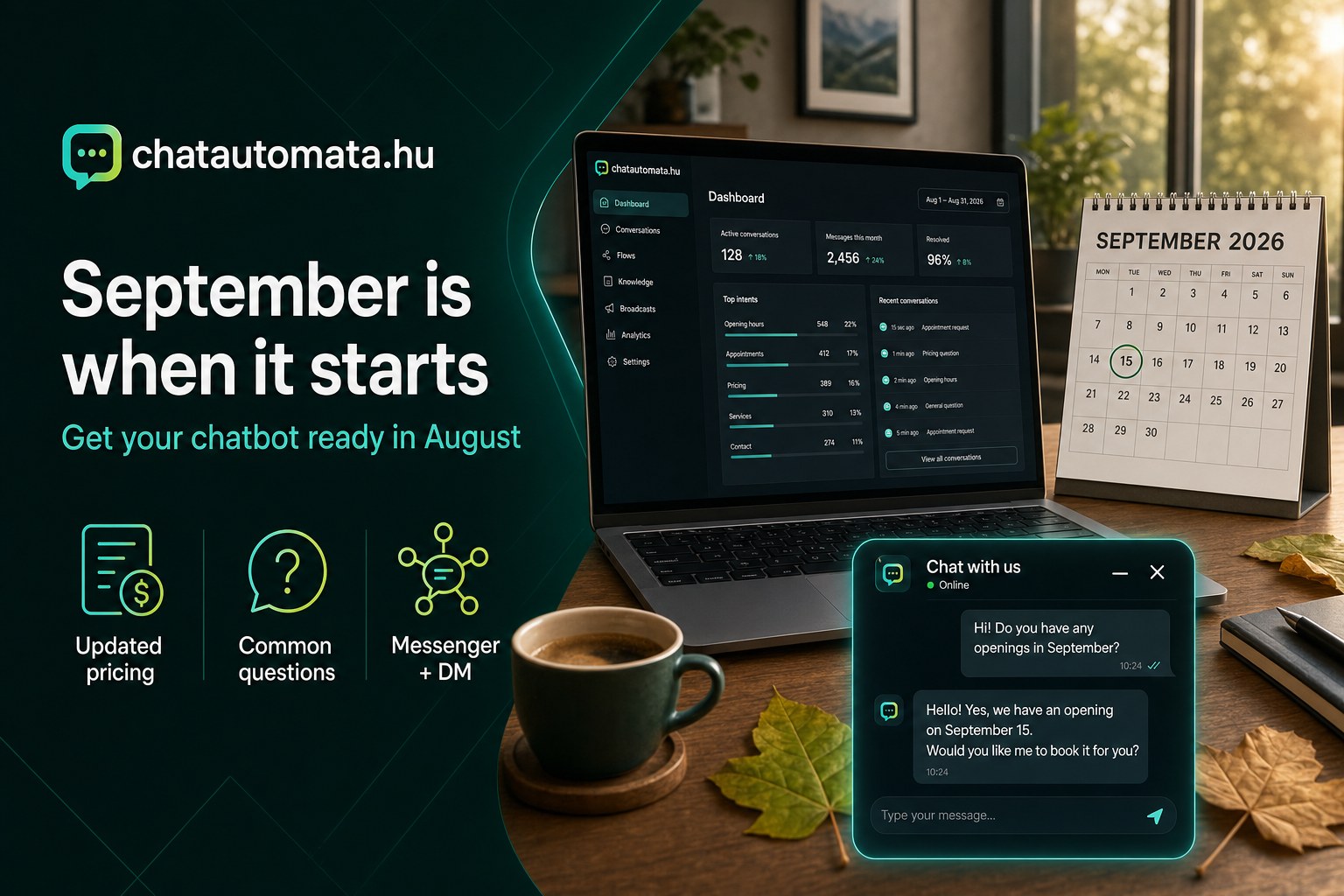
For most Hungarian small businesses the year does not start in January. It starts in September. At the end of August everyone comes home, children go back to school, and everything kicks off at once: the postponed dental check-up, the autumn course, the corporate headshots, the webshop season.
The trouble is that most people start preparing for this in the first week of September — by which time the rush has already arrived.
August, on the other hand, is exactly the month when things are quiet enough that an afternoon of work can get your chatbot ready for what is coming.
What is happening in your inbox right now
Two things at once. Fewer enquiries arrive, because half the country is on holiday. But the people who do write are often planning for September — booking ahead, asking for autumn quotes.
Together these make a trap. During the quiet spell you handle enquiries more loosely, and those are precisely the ones that turn into autumn revenue.
And there is a third factor: if you take a week off yourself, then for a week nobody gets an answer. The enquirer does not wait — they move on.
What "autumn season" means depends on your trade
Worth thinking through what specifically picks up for you, because that determines what the bot needs to handle.
Photographers see corporate headshots and family autumn sessions from September, then the Christmas season from November — which people book in autumn. Anyone asking in October about a December slot is a serious enquiry.
Beauty salons open the season with post-holiday repair work: colour, nails, facials. Most questions are about available slots, which is exactly where the time goes if you answer each one individually.
Medical practices get the postponed check-ups. Many questions must not receive a specific clinical answer — here it matters most that the bot hands the case over rather than guessing.
Education peaks in late August: when does the group start, are there places left, can I pay in instalments. This is the sector where questions repeat most, so a well-filled knowledge base pays off fastest.
Webshops ramp up through autumn towards Black Friday. Order status and delivery time are the two most common questions, and both are entirely predictable.
First question: is your knowledge base still accurate?
This is the most important step, and the one most often skipped.
The chatbot answers from what you uploaded: your price list, service descriptions and FAQ. It does not guess — if it cannot find something in your material, it asks for an email address and passes the question to you.
That is good news, because it will not invent things. But it also means that if the price list you uploaded is still the spring version, the bot will quote spring prices.
Check in August:
- Have your prices changed from September?
- Is there a service you no longer offer?
- Is there a new one the bot does not know about?
Ten minutes, and you avoid an awkward misunderstanding for the next six months.
The ten questions you will be asked a hundred times
Every trade has ten questions that account for eighty percent of enquiries. For a photographer it is how many photos and when they arrive. For a dentist, whether it hurts and what it costs. In education, when the group starts and whether there is space.
You know these by heart. Write them down once, and the bot answers them for you.
One tip that matters: write down what you actually say, not the marketing version. If someone asks how long it takes, the answer should not be "the duration of our service varies" — it should be "usually about ninety minutes, but if there are several of you, count on two hours".
The bot is only as good as the answers you feed it are human.
There is a side benefit. When you write out those ten answers, you often discover they are missing from your website too. If a question is common enough to teach the bot, it probably deserves a paragraph on the site — and there Google can see it.
What not to expect from it
Worth being honest about the limits. A chatbot will not sell what you cannot sell, and it should not decide things that need your judgement.
Three things are better left off its plate:
- Individual pricing. If a job's price depends on what you see on site, let the bot collect the details and quote it yourself.
- Sensitive matters. Health complaints, legal situations, complaints about your service — the right behaviour is a polite handover.
- Final commitments. If you do not want anything confirmed automatically, set it to record only. Approval stays with you.
A chatbot earns its place by removing repetitive work, not by taking on everything. One that answers every question will eventually answer one it should not have.
Opening hours, holidays, capacity
Two things to review at the end of August: when you are available, and how much you take on.
If your hours change from September, the bot will only know if you tell it. The same goes for working different days in autumn, or a service pausing.
And if you are away for the rest of the summer, this is when the chatbot earns the most. A good guest experience does not come from getting an instant appointment — it comes from getting a sensible answer and knowing when to expect you.
Set it up now and you will have data by September
There is an advantage to not starting in September: by the time the season begins, you will know what people actually ask.
The conversations show what visitors cannot find on your website. If fifteen people ask the same thing, that is not a chatbot problem — it is a missing page or a badly written price list.
That feedback alone is worth more than the time saved. And you only get it if you have a week or two for it to accumulate.
The August list
- Update the price list and service descriptions to the September state.
- Write out the ten most common questions and your answers, in your own words.
- Set your autumn opening hours and note anything that is pausing.
- Connect Messenger and Instagram DM if you have only had the website widget so far.
- Read the conversations a week later — what are people asking that you have no good answer to?
The fifth step is the most important and the most often skipped. A chatbot does not become good because you launch it, but because you read what people write to it.
What does it cost to try?
Nothing, if you are only trying it. There is a free tier with no time limit, and the paid plans can be used for 14 days without entering a card — so you do not have to commit in advance to build it in August and see in September whether it works.
If you are new to the topic, we have put together an introduction to what a chatbot is and what it does for a small business. If you would rather see it: the demo builds a bot from your own website content in about a minute.
And if you want the setup for your specific trade, there are breakdowns by sector — photographers, beauty studios, medical practices, law firms, education and webshops.
September is coming either way. The only question is whether it finds you ready.